



Services
AI-generated code review
Teams now ship more code written by coding assistants and agents than they can comfortably read. We review that code for correctness, security, licensing hygiene, hidden duplication, over-engineering and test adequacy - and help you set up a review practice that keeps pace.

Who this is for
For teams where AI writes faster than people can review
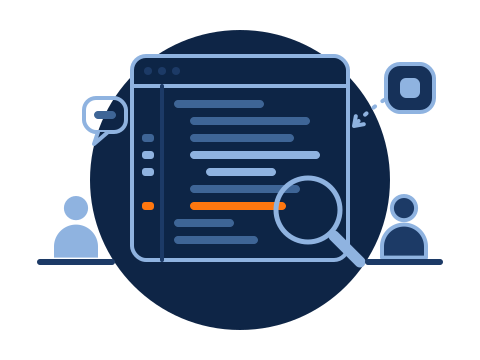
Reviewing AI written code is different from reviewing a colleague. The code looks plausible, arrives in large batches and can hide subtle errors, copied patterns or needless complexity. An outside review gives you a clear picture of what is really in your repository.
Teams that adopted assistants or agents quickly
You want to know what quality, security and maintainability risks have built up since.
Products in regulated or sensitive domains
Healthcare, fintech and retail teams that need evidence that AI-generated changes were checked properly.
Leaders preparing for scale, audit or due diligence
You need an AI code quality audit before a launch, an investment round or a major release.
What we do
Review that starts with the riskiest code
We keep the substance of a classic code review - performance, maintainability, security and technical debt - and adapt it to code produced with AI.
Baseline audit
We audit a repository or a window of recent commits to see where AI-generated code sits and how it differs from the rest.
Risk-tiered review
Security-sensitive paths come first: authentication, session and token handling, access control, payments and data handling.
Correctness and security
SAST scans plus manual reading for logic errors, missing input validation, injection risks and unsafe defaults.
Licensing and IP hygiene
We look for code that may be copied from sources with incompatible licences, and for secrets or data that should not be there.
Duplication and over-engineering
Hidden duplication, needless abstraction, inefficient queries and N+1 problems that add technical debt and cost.
Test adequacy
We check whether tests really verify behaviour, or only mirror the code an assistant wrote alongside them.
What you get
Findings, fixes and a review practice
The aim is a cleaner codebase today and a sustainable way to review AI output tomorrow.
- Findings report. issues ranked by risk, each with a concrete fix or a suggested change.
- Security summary. vulnerabilities and unsafe patterns found, with remediation guidance.
- Review guidelines. checklists for reviewing AI written code, tuned to your stack and risk areas.
- Tooling setup. AI-assisted review tools configured with human approval gates where they matter.
- Review metrics. a few signals to track review effort and escaped defects over time. [TBD: metric]
- Optional review cadence. ongoing periodic reviews of new code, agreed with you.
How it works
From baseline to a lasting habit
Step 01
Baseline
We agree scope, gain read access and audit the repository or recent commits.
Step 02
Review
We review by risk tier and record findings with concrete fixes.
Step 03
Guide
We share findings with your team and turn the recurring issues into review guidelines.
Step 04
Sustain
We help set up tooling and metrics, and can continue with a regular review cadence.
FAQ
Frequently asked questions
No. We review the whole change set, but we look harder at the failure modes common in AI-generated code. In practice most repositories now mix both.
We use automated and AI-assisted tools to cover ground quickly, and an experienced engineer makes every judgement that matters. For continuous, commit-level feedback between reviews, see our product Improvise.
Yes. Guidelines, tooling and training are part of the work, and our AI Training for Teams programmes go further.
Related offerings
Keep exploring.
AI SDLC Consulting
All seven offerings for AI-enabled software delivery.
Loop Engineering
Design the workflow your engineers and AI tools work in.
Right Tool for Each SDLC Stage
Choose the AI tools that fit each stage of delivery.
AI Training for Teams
Hands-on programmes for working well with AI tools.
Improvise
Developer feedback reports on every commit - the automated companion to human review.
Contact Stavir
Tell us how much of your code is written with AI today.