



AI SDLC Consulting
LLM model selection for software teams
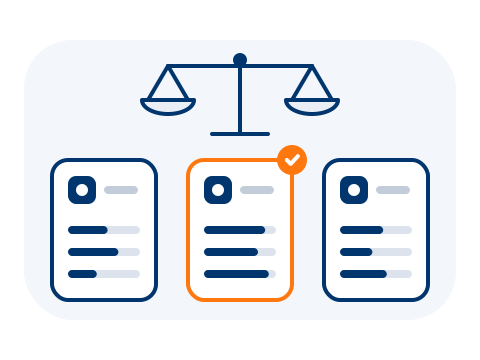
No single model is best at everything. The one that writes good code may be slow for review, expensive for documentation or unsuitable for data that must stay in a particular region. We help you choose a model for each engineering task, using evidence from your own work rather than leaderboards.
Who this is for
For teams that need to choose models on evidence
New models arrive constantly and every vendor claims to lead. Without a way to compare them on your own tasks, choices default to habit or marketing. We are vendor-neutral and have no model to sell.
Engineering leaders standardising AI use
You want a clear, defensible default for each task and a way to revisit it as models change.
Teams with data residency or compliance limits
Healthcare, fintech and other regulated teams that must know where code and data are processed.
Platform teams watching AI spend
You need to balance quality against cost and latency rather than using the largest model for everything.
What we do
We compare models on your tasks
Every recommendation is grounded in tests run against your codebase and constraints.
Map tasks to needs
List the engineering tasks you use AI for - coding, review, documentation, test generation - and what matters most for each.
Set hard constraints
Capture data residency, retention, licensing and compliance requirements that rule options in or out before quality is considered.
Build an evaluation harness
A repeatable set of tasks drawn from your own repositories, with scoring you can rerun whenever a new model appears.
Compare vendor and open-weight options
Assess hosted and self-hosted models side by side on quality, latency and total cost for each task.
Design routing
Decide which model handles which task, and when to fall back or escalate, so each request uses a sensible option.
What you get
What you walk away with
Evidence and tooling your team can keep using as the market moves.
- Task and constraint matrix. each engineering task with its quality, latency, cost and compliance needs.
- Evaluation harness. task sets and scoring scripts in your repository, ready to rerun.
- Comparison report. results per task, with trade-offs explained in plain language.
- Model policy. approved models per task, data-handling rules and the review cadence.
- Cost model. expected usage and spend per task. [TBD: metric]
How it works
How model selection works
Step 01
Scope
We agree the tasks, constraints and candidate models with your tech leads and security team.
Step 02
Evaluate
We build the harness, run the candidates and review results with the engineers who will use them.
Step 03
Decide
We write the model policy and routing rules, and agree when to re-evaluate.
FAQ
Frequently asked questions
That depends on your tasks and constraints, which is the point of the evaluation. We do not hold vendor partnerships that steer our advice.
Sometimes. They can help with data residency and cost control but bring hosting and maintenance work. We compare them on the same terms as hosted options.
Whenever a credible new option appears or your needs change. Because the harness is yours, a rerun is a small task rather than a new project.
Related offerings
Keep exploring.
AI SDLC Consulting
All seven offerings for AI-enabled software delivery.
Right Tool for Each SDLC Stage
Vendor-neutral tool selection without the sprawl.
Prompt Engineering
Reusable, versioned, testable prompts for engineering teams.
Loop Engineering
A plan, generate, review, test, refine loop your team can trust.
Contact Stavir
Tell us how your team works with AI today.